

One of the primary tasks of universities is to educate future professionals and this goal is not only achieved through traditional pedagogical methods. The World Economic Forum identifies future core working life skills like analytical and creative thinking, self-efficacy, resilience, flexibility, agility, self-awareness, and the ability to utilize technology. (The World Economic Forum 2023). These skills are not necessarily achieved through lecture-based teaching alone. Learning is often more sustainable, inspiring, and motivating when students are active participants and do real-life development WLC projects with companies as the HEIComp has shown.
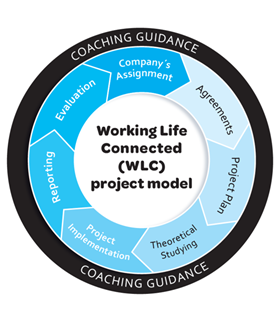
Coaching Guidance
The role of the teacher in the WLC project model is to support the development of students’ skills through coaching guidance. Instead of providing direct answers or solving challenges for the student, the teacher utilizes the students’ resources and strengths to help them find their own insights and solutions. This process supports the student’s professional self-esteem and the development of working life skills. (Tallgren & Uusitalo 2022 a, Tallgren & Uusitalo 2022 b.)
Coaching guidance merges solution-focused coaching with coaching leadership philosophy. It emphasizes leveraging an individual’s strengths and resources to achieve goals, with the coachee being the expert of their own life. The coach supports them in finding solutions and insights through a process involving five stages: goal setting, identifying strengths, leveraging these strengths, creating an action plan, and progressing step by step. It relies on active listening, providing insights, challenging assumptions, and boosting self-belief. (Whitmore & Gaskell 2024.)
Coaching leadership focuses on developing, supporting, and ensuring the well-being of individuals and teams. It aims to create a trusting and interactive work or learning environment where all feel valued and motivated. This leadership style encourages individuals to take responsibility for their work, with leaders clarifying goals, supporting creativity, and providing feedback. The emphasis is on recognizing successes and transforming the working team culture from focusing on mistakes to celebrating achievements. (Whitmore & Gaskell 2024.)
Key Coaching Tools and Methods in Education
Creating a Positive Environment: The teacher as a coach encourages open communication and helps the team set goals and rules for their work. One very effective tool for supporting goal setting is the GROW model. This is used for defining the aims, assessing the current situation, exploring alternatives, and developing an action plan. (Whitmore & Gaskell 2024.)
Regular Meetings and Dialogue: Active listening and engaging in dialogue in meetings build trust and help students gain new insights. The coach provides feedback and supports students’ viewpoints. (Whitmore & Gaskell 2024.)
Asking Open-Ended Questions: Open questions help students find their own solutions and perspectives, increasing commitment and enthusiasm. (Whitmore & Gaskell 2024.)
- Gathering information helps the teacher understand the students’ situation better: “Can you tell me more about your experience with that project?”
- Exploring the emotional aspects of a situation: “How do you feel about that?”
- Encouraging reflection and insight: “What did you learn from that experience?”
- Visioning and goal setting helps students envision their goals and plan steps to achieve them: “What does final result look like for you?”
- Handling unproductive responses without shutting it down: “That’s interesting, can you elaborate on that?”
Sharing and Giving Feedback: Regular feedback is crucial for learning and motivation. It starts with the student’s reflection and includes both positive and learning feedback, challenging students to step out of their comfort zones. (Whitmore & Gaskell 2024.)
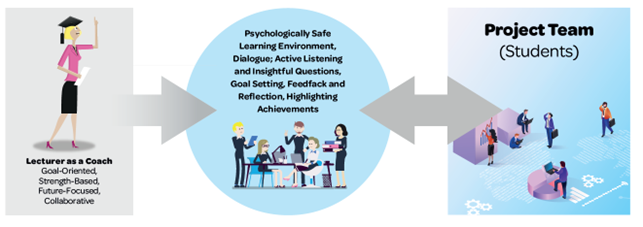
In WLC projects, coaching supports students with real-life assignments. This means that guidance must be quite flexible, adapting to different situations, and focuses on trusting the process and the team’s ability to grow and solve problems. The coach encourages independent and creative thinking, allowing the team to make decisions and learn from mistakes while ensuring professional growth. Coaching guidance is best implemented in a curriculum that supports holistic student development. A student-centered approach encourages active participation and responsibility, integrating theory with practice and providing continuous feedback to enhance learning and work-life skills. (Tallgren & Uusitalo 2022 a, Tallgren & Uusitalo 2022 b.)
Transforming Traditional Teaching into Coaching Guidance
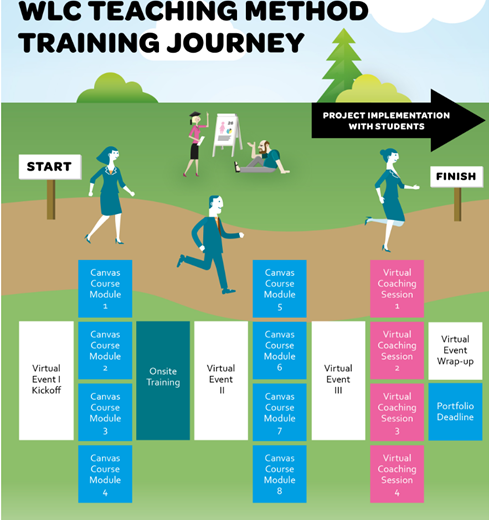
As part of the HEIComp teaching method training, teachers from partner universities from Brazil and Paraguay were trained to work as coaches in WLC projects. This research investigated how coaching training for lecturers achieved its goals as part of the HEIComp project in fall 2023. The target group of this study consists of Universidad Autónoma de Encarnación (UNAE) eight lecturers who coached their students for the first time in WLC projects assigned by companies. The UNAE coach first completed a virtual WLC training course (Figure 3), which included a theoretical package on coaching guidance. (Denis, Escurra & Tallgren 2025, 1746–1754.)
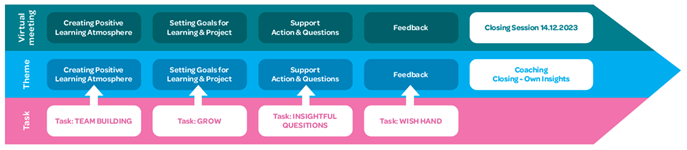
Secondly, a Laurea lecturer supported the UNAE coach during the first real-life WLC project by having virtual meetings once a month with an agreed theme. (Figure 4).
To examine how coaching training for UNAE lecturers achieved its goals as part of the HEIComp project, lecturers had to reflect on their own professional development as a coach through showcase portfolios (Figures 5 and 6). The portfolios of eight lecturers were analyzed and the analysis of the responses was conducted using a qualitative, descriptive methodology by creating thematic categories along two dimensions: 1) How do lecturers adopt the new role of a teacher as a coach? 2) How do lecturers master coaching teaching methods that enhance learning in WLC project studies? (Denis, Escurra & Tallgren 2025, 1746–1754.)
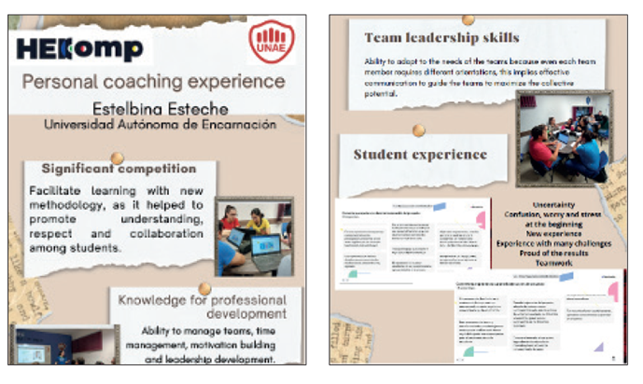
First, it was investigated how teachers adopted their new role as coaching guides. The results revealed that teachers were generally able to transition to a coaching approach, focusing on the process of insight rather than giving direct advice. Teachers felt they had succeeded particularly in supporting students’ independence, decision-making, and self-direction. However, the transition posed challenges for teachers, as they had to relinquish their authoritative role and trust in their students’ abilities to advance the project assignment. (Denis, Escurra & Tallgren 2025, 1746–1754.)
Secondly, it was investigated how teachers felt they had learned and mastered coaching methods. According to the results, teachers had integrated a variety of techniques into their guidance, including facilitating insights, providing feedback, and challenging students to think critically, broadly, and solve problems. In conclusion, teachers reported that their experience with coaching enriched them both personally and professionally. However, a successful transition from traditional teaching to coaching requires long-term practice in applying the method and familiarizing students with the approach. (Denis, Escurra & Tallgren 2025, 1746–1754.)
Could this be an update on what kind of WLC education you are doing these days?
Currently, UNAE carries out research and extension projects focused on solving problems of real companies in the region, in order to contribute to the university-industry partnership. All the courses of the different faculties work on these projects in an interdisciplinary way (all the subjects of the course collaborate through an objective) and through the WLC methodology.
@heicomp project is funded by #erasmusplus #capacitybuilding
Co-authors: Taru Tallgren & Liz Escurra Ferreira
Sources:
Denis, M., Escurra, L. & Tallgren, T. 2025. Transforming Traditional Teaching into Coaching Guidance in Working Life Connected Projects. INTED2025 Proceedings, pp. 1746-1754. Retrieved from https://urn.fi/URN:NBN:fi-fe2025040122965
Tallgren, T & Uusitalo, T, a. “Project Managers Coach Their Teams in Performance and Changeability,” in 14th International Conference of Education, Research and Innovation, pp. 2926- 2933, 2022, ISBN 978-84-09-45476-1, doi:10.21125/iceri.2022.0723
Tallgren, T & Uusitalo, T, b. “Development of Leadership Skills in Working Life Projects” in 14th International Conference on Education and New Learning Technologies, pp. 1977-1985, 2022, ISBN: 978-84-09-42484-9, doi:10.21125/edulearn.2022.0516
Whitmore, J and Gaskell, T. 2024. “Coaching for Performance: The Principles and Practice of Coaching and Leadership,” pp. 95 – 188, John Murray Business, 6th edition, 2024.
World Economic Forum, “Future of Jobs Report 2023”, Insight Report 2023, pp. 38, ISBN-13: 978-2-940631-96-4Retrieved from WEF_Future_of_Jobs_2023.pdf